
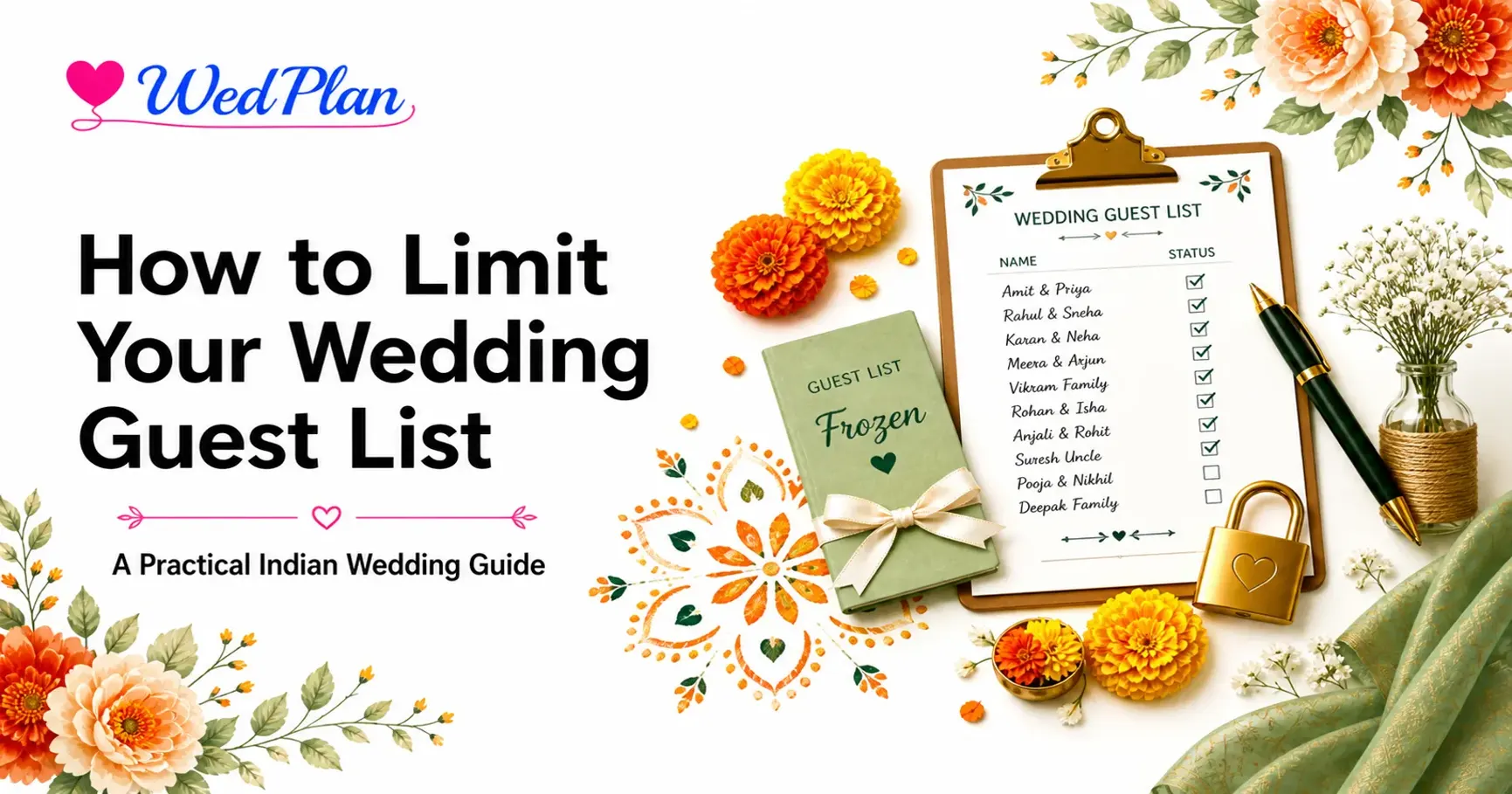
Every couple starts the same way. You sit down together, probably over chai, and agree: "We want to keep it intimate. Maybe 150 people, max." Six weeks later you're staring at a list with 340 names on it and wondering where it went wrong.
It went wrong the moment you handed a blank column to two sets of parents, each of whom has a completely different definition of "close family." It went wrong when you added your college roommate and your mother added the family of the person who invited her to their kid's wedding eleven years ago. It went wrong because nobody set the number first and treated it like a budget.
The good news: a runaway guest list is not a family problem or a cultural problem. It's a structure problem — and structure problems have solutions. This guide covers exactly that. Not the polite version where everyone agrees nicely. The actual version, where you hold a number under pressure and still make it to the other side with your relationships intact.
Why the Indian Wedding Guest List Always Grows
It helps to understand the specific mechanics before you try to fight them. The Indian wedding guest list grows for reasons that are, individually, completely reasonable. Your parents want to invite people who attended their children's events — skipping them would cause real offence. Your mother's sister was at your cousin's wedding; not inviting her would be noticed and discussed. There's a social accounting happening in parallel to your planning, and it has its own logic.
The problem is that this logic has no built-in ceiling. Every inclusion creates an obligation that implies another inclusion. The mechanic is recursive: A invited B, so you have to invite C because C and B are close, and if C is coming then D needs to come too. This isn't bad faith — it's how the social fabric of large family networks actually works. You're not fighting irrationality; you're fighting a system that was never designed with a 150-person cap in mind.
Knowing this changes how you approach the problem. You're not going to win by explaining your budget or asking people to be "reasonable." You win by deciding the number before any names go on paper, making that number non-negotiable in the same way your venue date is non-negotiable, and then working within it together.
Start With the Number, Not the Names
Before anyone opens a contacts list or a family WhatsApp group, you and your partner need to align on one number. Not a range — a number. "Between 150 and 200" is not a number; it's an invitation for the list to settle at 200. "150" is a number.
That number should come from two places: your budget and your vision. If you've set a catering budget of ₹18 lakh and your caterer charges ₹1,800 per plate for a full sit-down dinner, you have a ceiling of roughly 100 covers before you've spent anything on decor, photography, or the venue. Work backwards from what you can actually spend. The guest count that works for your budget is your number.
Your vision matters too. A 300-person wedding and a 120-person wedding are genuinely different events. At 120, you will speak to every person there. You'll remember the night differently. If intimacy is part of what you want, let that inform the number — and say it clearly to your families: "We want an event where we can actually spend time with everyone who's there. That means keeping it to 130."
Once you have the number, split it. A simple way: allocate a third to the bride's family, a third to the groom's family, and keep a third for the couple's own friends, colleagues, and choices. This immediately creates a framework that parents can work within, rather than a blank canvas that produces chaos. If one side consistently uses their entire allocation and the other doesn't, you can revisit — but start with equal splits. It removes the perception of favouritism from the start.
The Tier Method — Who Actually Makes the Cut
The most practical framework for deciding who's in and who isn't is the tier method. You build three groups privately, before any family involvement, and your total across all three is your maximum.
The first group — call it Tier One — is non-negotiable. These are the people whose absence would genuinely change the meaning of the day: immediate family, your closest friends, the people who've been present for the relationship since the beginning. This list should be short. If it runs above 50 or 60 names, you're not being ruthless enough. Tier One is the heart of the wedding. Everyone else is extending outward from it.
The second group — Tier Two — is close but not central. Extended family you're genuinely fond of, friends from different life chapters who matter to you, colleagues who are more than just colleagues. These people belong at your wedding if the numbers allow. They don't belong simply because of obligation or reciprocity. The test: if this person's name came off the list tomorrow, would you feel a genuine personal loss, or would you mostly feel awkward about what they'd think? Genuine loss stays. Awkwardness doesn't.
The third group — Tier Three — is obligation. The family friend your parents have known since before you were born. Your father's business associate. The neighbours whose kids you played with twenty years ago but haven't spoken to since. These are people who would be hurt by the absence of an invitation, but whose presence wouldn't meaningfully change your experience of the day. When the list needs to shrink, it shrinks from here first.
One more thought on the tier method: build your lists honestly, even if you never show them to anyone. The uncomfortable act of placing someone in Tier Three — instead of padding them into Tier Two because you feel guilty — is what keeps the whole exercise from being pointless.
The Conversations Nobody Wants to Have
The list itself is the easy part. The list lives on a spreadsheet; the conversations happen with people. And some of those people have feelings about weddings that predate you entirely.
When a parent pushes back on your number — "but we can't not invite them, it will look very bad" — it helps to separate the conversation from the names. Don't argue about whether a specific person belongs on the list. Argue about the number. "We've decided on 150. You have 50 spots. Who you put in those 50 is completely your decision. But 150 is the ceiling." A constraint conversation is easier than a judgement conversation.
When a family member expects an invitation and doesn't receive one, the most dignified response is warmth without apology. "We had to keep the wedding very small — we kept it only to immediate family and our closest people. I hope you understand." You're not explaining or justifying; you're stating a fact about the nature of the event. Small is a legitimate choice. You don't owe anyone a full accounting of why you made it.
When a friend is hurt that they weren't included — and this is usually harder than family, because the relationship doesn't carry the same cultural buffer — be more personal. "I wanted to be honest with you: we had to keep the numbers very tight, and I genuinely wish it had been different." That's often enough. Most adults understand budget and logistics. What they need is to know they weren't forgotten.
Handling the "What About My Side?" Pressure
In most Indian weddings, the families aren't just providing names — they feel they have a stake in the count. A small wedding can feel like a statement about status, about how well-connected the family is, about what the neighbours and relatives will say. This is real. Dismissing it as irrational doesn't help.
The most effective approach is to make the constraint visible and equal from the start. Both sides have the same number of spots. Both sides face the same ceiling. When the pressure comes from one family — and it usually does, more from one than the other — you can point to the structure itself: "Both sides have the same allocation. We can't give one side more without reducing the other." The structure becomes the reason, not you.
There's also a practical conversation worth having early: tell parents that you are the ones who will communicate with uninvited guests, not them. Taking that job off their plate removes one of their biggest objections — the awkwardness of having to explain to someone why they weren't invited. When they know you'll handle it, the resistance to cutting often softens.
Finally, if the pressure is genuinely about community standing rather than personal relationship — parents who need to be seen to have hosted a certain number of people — consider a separate celebration. A smaller, intimate wedding for 120, followed by a larger reception a month later for the broader network, is increasingly common and solves both problems cleanly. The wedding stays intimate. The community sees the celebration. Everyone has what they actually need.
Keep your guest list organised from day one
WedPlan lets you tag every guest by family side, event, and relationship tier — so headcounts are always accurate and you can freeze the list when it's ready.
Sign up freeFreezing the List — and Actually Meaning It
Cutting the list is hard. Keeping it cut is harder. The moment invitations go out, someone will approach you with a "just one more" — a late addition that feels reasonable in isolation but sets a precedent that unravels the whole thing. You need a freeze date, and you need to treat it with the same finality as the wedding date itself.
Set the freeze date at least six weeks before your first function, ideally earlier. Before that date, additions require mutual agreement between both partners. After that date, the answer is no — not "let me see," not "maybe if someone doesn't come." No. This sounds harsh, and it will feel harsh the first time you apply it. But it is the only approach that works. Every exception creates the expectation of another exception.
Communicate the freeze clearly to both families before it happens. Not as a threat, but as a logistics reality: "We'll need final numbers for the caterer and the venue by this date. After that, we won't be able to add names." Framing it around catering headcounts removes the personal dimension and places it in operational reality. Caterers and venues actually do need final numbers — you're not inventing a constraint.
It also helps to close the list in a system, not just a conversation. When your guest list lives in WedPlan and your families can see it, the number is visible and real in a way that a spoken agreement isn't. "We're at 148, we have two spots left" is a different kind of fact than "we're keeping it small." One is abstract; the other is a number someone can see.
The B-List — When It Helps and When It Backfires
A B-list is a set of names you'd genuinely like to invite if space opens up — people who were cut from the original list not because they don't belong there but because the numbers didn't allow it. Used carefully, it's a legitimate tool. Used carelessly, it creates hurt feelings and a reputation problem.
The B-list works under one condition: nobody on it can know they're on it. The moment a guest discovers they received their invitation after someone else declined — and people do find out, sometimes from the most unexpected sources — the invitation becomes an insult. The B-list is a private document between you and your partner. It is never shared, never hinted at, and never mentioned to family members who might mention it to others.
The practical window for a B-list is also narrow. You need enough time between declining RSVPs arriving and your venue and catering deadlines to issue new invitations that don't look obviously last-minute. That typically means setting your RSVP deadline at least three to four weeks before the first function. If your timeline doesn't allow for that gap, skip the B-list entirely. The operational complexity isn't worth the risk of someone feeling like a backup option.
One more thing: keep the B-list short. Ten to fifteen names, maximum. A B-list of forty people isn't a B-list — it's evidence that the original list was too aggressive in its cuts, and that you're hoping attrition does the work the conversations didn't.
What a Well-Limited Guest List Actually Gives You
It's worth saying plainly, because it gets lost in the difficulty of the process: a smaller guest list is a genuinely better wedding experience for almost everyone there, including you.
At 120 people, you will speak to every table. You'll remember faces. When something goes unexpectedly well — a speech that landed, a moment between your grandparents on the dance floor — you'll be present enough to notice it. At 350 people, the evening becomes a logistical event you survive rather than a celebration you inhabit.
The financial reality is just as real. Every person removed from the guest list saves roughly ₹3,500 to ₹6,000 in catering alone, depending on your menu and city. A hundred fewer guests is ₹3.5 to ₹6 lakh that can go into better photography, a nicer venue, or simply your savings. The guest list is the most direct lever on your wedding budget — more direct than almost any other decision you'll make.
And there's something else that's harder to quantify. A wedding with 120 people who genuinely love you and wanted to be there has a different feeling in the room than a 350-person event where 200 people came because of social obligation. Guests feel it. You feel it. The photographs look different. It's the difference between a party that happened and a celebration that meant something.
Guest list, RSVP, and WhatsApp invites — all in one place
WedPlan keeps your guest list structured from the first name to the freeze. Tag by side, by event, by tier. Know your headcount at any moment. Start free.
Sign up free